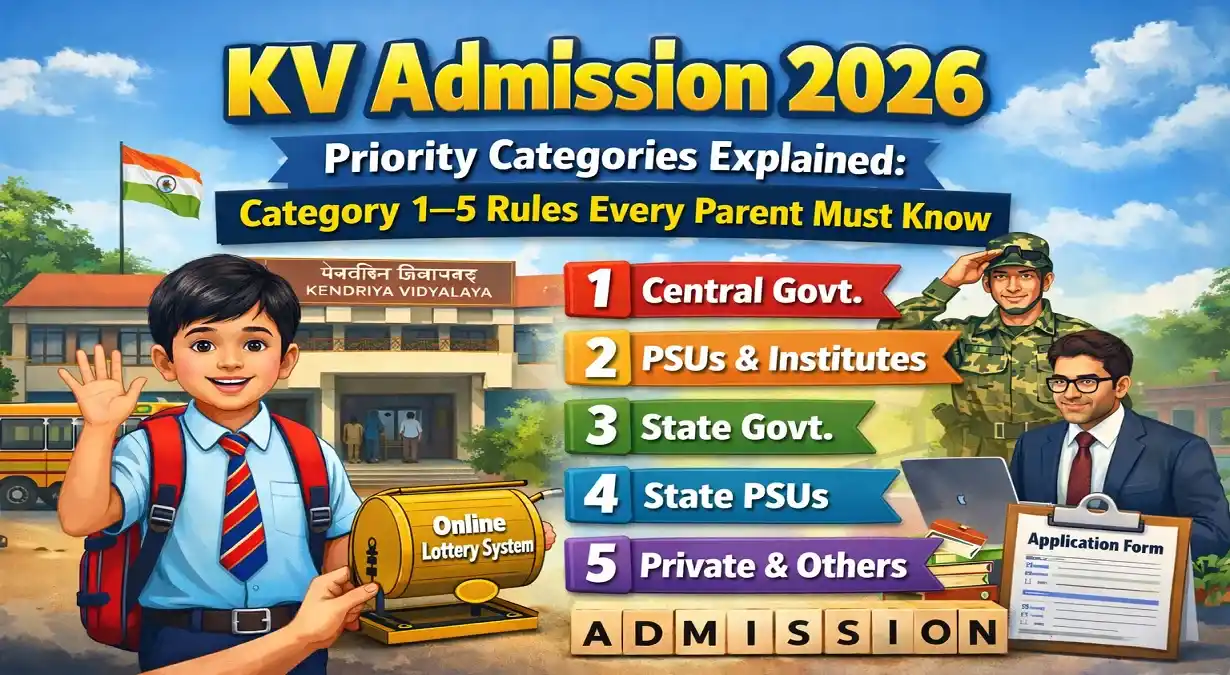
KV Admission 2026 Priority Categories Explained: Learn how Kendriya Vidyalaya Sangathan (KVS) allocates seats using the official priority category system from Category 1 to Category 5. This detailed guide helps parents understand which applicants receive the highest priority in KV admissions, including children of central government employees, defense personnel, PSU staff, state government employees, and private sector families.
If you are planning to apply for KV Admission 2026-27, this detailed guide will help you understand eligibility criteria, required documents, priority categories, age limit and important tips to improve your chances of securing a seat.
Also Read: KV School Admission 2026-27
KV Admission 2026-27 Overview
The admission process for Kendriya Vidyalaya schools is managed centrally by Kendriya Vidyalaya Sangathan, which operates hundreds of schools across India. These schools were originally established to ensure continuity of education for children of transferable central government employees, including defense personnel. However students from all backgrounds can apply, though admission is granted based on a priority category system.
Key highlights of KV Admission:
- Admission for Class 1 is conducted through an online lottery system
- Applications are accepted through the official KVS portal
- Seats are allocated based on priority categories
- 25% seats are reserved under the RTE quota
Because the number of applicants is extremely high, understanding the rules and categories beforehand is very important.
Essential Documents Required for KV Admission
Before starting the online application, parents should keep all required documents ready. The KVS portal strictly verifies all information provided during registration.
If the documents do not match the submitted details, the admission may be cancelled even after selection.
1. Birth Certificate
The birth certificate is the most important document for Class 1 admission.
It must be issued by an authorised authority such as:
- Municipal Corporation
- Village Panchayat
- Military Hospital
Ensure that the child’s name and date of birth match exactly with the information entered in the application form.
2. Child’s Passport-Size Photograph
A recent passport-size photograph of the child must be uploaded during registration.
Important requirements include:
- JPG format
- File size generally under 256 KB
- Clear and recent image
3. Address Proof
Parents must provide proof of residence to confirm that they live within the school’s admission radius.
Common documents accepted include:
- Aadhaar Card
- Electricity bill
- Water bill
- Registered rent agreement
For students applying under the RTE quota, the residence distance requirement is stricter.
Category-Specific Documents
Some applicants may need additional documents depending on the category they apply under.
Service Certificate
Parents applying under priority Categories 1–4 must submit a service certificate signed by the Head of Office.
This document confirms the employment details of the parent.
Transfer Certificate Details
Transfer history plays a major role in KV admissions for government employees.
Parents must list all transfers made during the last 7 years.
Conditions include:
- Minimum 20 km transfer distance
- At least 6 months stay at each location
More transfers generally mean higher priority during the lottery process.
Caste Certificate
Students applying under reserved categories must submit a valid certificate for:
- SC
- ST
- OBC (Non-Creamy Layer)
The certificate may be issued in the child’s or parent’s name, though the child’s certificate is preferred.
EWS / BPL Certificate
Students applying under the Right to Education quota must provide a valid EWS or BPL certificate issued by the state government.
Single Girl Child Affidavit
Families with only one daughter can apply under the Single Girl Child (SGC) quota.
This requires:
- A notarized affidavit
- Rs. 100 stamp paper declaration
This quota provides additional admission opportunities for girl students.
KV Admission Priority Categories Explained
Unlike many private schools, KV admissions are not based on first-come-first-served applications.
Instead, seats are allocated according to priority categories defined by KVS.
Understanding these categories is crucial for parents.
Category 1: Central Government Employees
Category 1 is the highest priority group in KV admissions.
This includes children of:
- Transferable Central Government employees
- Non-transferable Central Government employees
- Ex-servicemen
- Foreign officials working on deputation with the Government of India
Defense personnel from organizations such as:
- Army
- Navy
- Air Force
also fall under this category.
Since these jobs require frequent transfers, the KV system was designed primarily to support such families.
Category 2: Central PSU and Autonomous Body Employees
Category 2 includes employees working in organizations that are owned or funded by the Central Government but are not government departments.
Examples include employees of:
- Public Sector Undertakings
- Government research institutions
- Autonomous educational institutes
Some well-known institutions include:
- Oil and Natural Gas Corporation
- Bharat Heavy Electricals Limited
- Indian Institutes of Technology
Children of employees from these organizations receive second priority in the admission process.
Other KV Admission Categories
After Category 1 and 2, the remaining categories are considered in the following order:
Category 3
Children of State Government employees.
Category 4
Children of employees working in State Government PSUs and autonomous bodies.
Category 5
This includes all other applicants, such as:
- Private sector employees
- Self-employed parents
- Business owners
Most parents from the general public fall into this category.
Age Limit for KV Admission 2026-27
For Class 1 admission in the 2026-27 academic session, the age eligibility rules are based on the National Education Policy (NEP) guidelines.
Age requirements are:
- Minimum Age: 6 years
- Maximum Age: 8 years
The child must fall within this age range as of 31 March 2026.
Children born on 1 April are also considered eligible according to KVS rules.
RTE Quota in Kendriya Vidyalaya Admissions
Under the Right to Education (RTE) Act, 25% of seats in every Kendriya Vidyalaya are reserved for students from economically weaker sections.
Key benefits of RTE admissions:
- Priority in seat allocation
- Free education support
- Equal opportunity for underprivileged students
However, applicants must live within a specified distance from the school.
Distance requirements usually include:
- 5 km radius for urban areas
- 8 km radius for rural areas
Students meeting these conditions are included in a separate lottery process.
Important Tips for KV Admission Application
Parents can improve their chances of a smooth application process by following these important tips.
- Verify Distance from School
Use Google Maps to accurately check the distance between your residence and the school.
Incorrect distance claims can lead to application rejection.
- Apply to Multiple KVs
Parents are allowed to apply for up to three Kendriya Vidyalayas in a single application form.
Choosing schools wisely based on proximity can increase the chances of selection.
- Double-Check Transfer Records
Government employees must ensure that all transfer details are accurate.
Even minor mistakes in dates or locations may lead to disqualification during verification.
- Keep Your Mobile Number Active
All communication from Kendriya Vidyalaya Sangathan will be sent through:
- SMS
- OTP verification
Therefore, the registered mobile number must remain active throughout the admission process.
FAQs: KV Admission 2026 Priority Categories Explained
1. What are KV Admission Priority Categories?
KV Admission Priority Categories are groups defined by Kendriya Vidyalaya Sangathan to decide which applicants receive preference during the admission process.
2. Who comes under Category 1 in KV Admission?
Category 1 includes children of Central Government employees, defense personnel, and ex-servicemen. This group receives the highest priority.
3. What is Category 2 in KV Admission?
Category 2 includes children of employees working in Central Government Public Sector Undertakings (PSUs) and autonomous bodies like IITs and NITs.
4. Can private sector employees apply for KV Admission?
Yes, private sector employees can apply under Category 5, which includes all applicants not covered in government categories.
5. How are seats finally allotted in KV Admission?
Seats are allotted through an online lottery system after considering priority categories and eligibility criteria.
Conclusion
Securing admission in a Kendriya Vidyalaya is a major achievement for many families. These schools offer excellent academic standards, cultural diversity and strong extracurricular development opportunities. Although the priority category system may seem complex, the transparent online lottery process ensures fairness for all applicants.
Parents should start preparing early by collecting documents, understanding eligibility rules, and carefully filling out the application form. With proper planning and accurate information, the KV Admission 2026-27 process can become much smoother and stress-free.
Related Posts