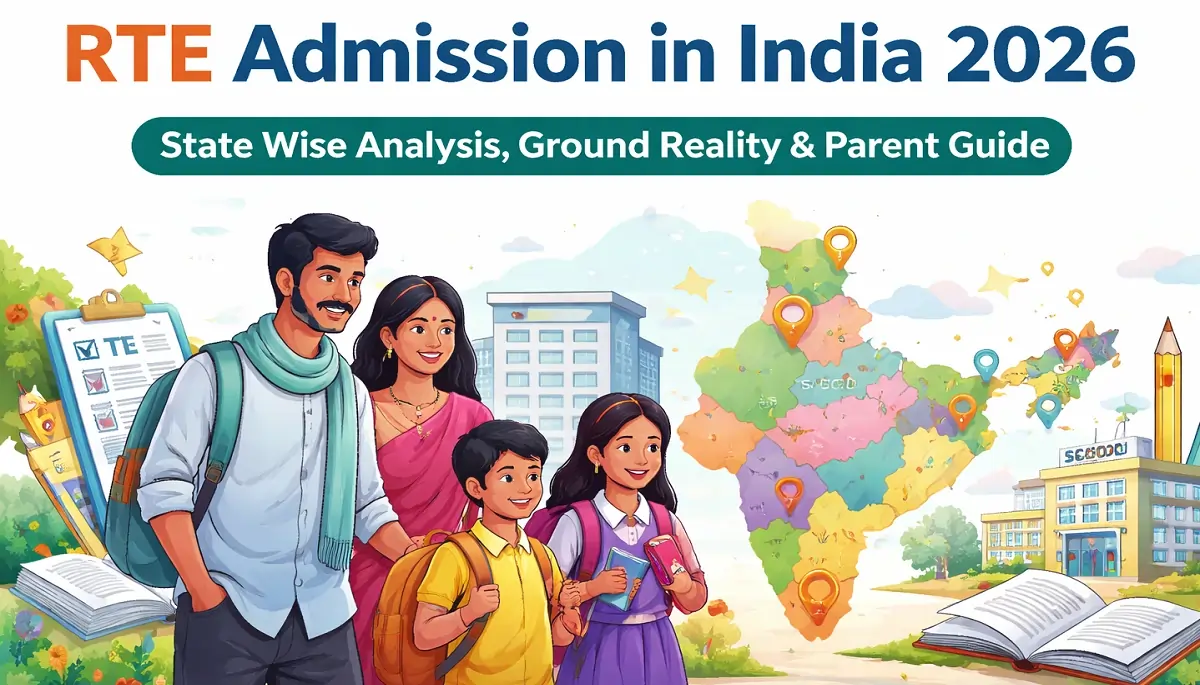
The RTE Admission in India (RTE) Act was introduced to reduce this gap and provide equal educational opportunities. Under this law, 25% seats in private unaided schools are reserved for children from Economically Weaker Sections (EWS) and Disadvantaged Groups (DG). While the policy is the same nationwide, its implementation differs significantly across states. This blog explains the real ground situation in simple language.
What is RTE Admission in India 2026 and Why Is It Important
The RTE Act guarantees free and compulsory education for children between 6 and 14 years of age. The most impactful provision is the 25% reservation in entry-level classes of private schools.
For many families, this means:
- Access to quality education
- Better infrastructure and facilities
- Improved exposure and confidence
- Equal learning opportunities
Download Notification Click Here
For a daily wage worker, small vendor, or low-income family, RTE admission is not just a formality. It represents hope for social mobility and a better future for their children.
Overview of RTE Admission in India 2026
| Topic | Details |
|---|---|
| Scheme Name | Right to Education (RTE) Admission |
| Launched By | Government of India under the Right to Education Act, 2009 |
| Purpose | To provide free and compulsory education to children from economically weaker sections (EWS) and disadvantaged groups. |
| Admission Year | Academic Session 2026–27 |
| Eligible Classes | Mostly Nursery, LKG, UKG, or Class 1 (depending on state rules) |
| Age Limit | Generally 3 to 7 years (varies by state and class level) |
| Reserved Seats | 25% seats reserved in private schools under RTE quota |
| Who Can Apply | Children from Economically Weaker Sections (EWS) and disadvantaged categories |
| Application Mode | Online through the respective state RTE admission portal |
| Selection Process | Lottery system conducted by the state education department |
| Benefits | Free education including tuition fees, books, and uniforms in many states |
| Official Authority | State Education Departments / School Education Boards |
State-Wise RTE Admission 2026 Performance in India
UP RTE Admission 2026-27
Uttar Pradesh receives one of the highest numbers of RTE applications every year due to its large population. Awareness campaigns have improved participation.
However, common issues include:
- Delays in document verification
- Late admission confirmation
- Reimbursement delays affecting schools
Despite these challenges, the state records strong participation and high seat allocation numbers.
Rajasthan RTE Admission 2026-27
Rajasthan operates a structured online lottery system with multiple admission rounds.
Key challenges include:
- Backlog in processing applications
- Legal disputes related to eligibility
- Delayed government reimbursements
While the digital system is organized, procedural delays sometimes frustrate parents.
Maharashtra RTE Admission 2026-27
Maharashtra has one of the most advanced digital RTE systems, especially in urban areas like Mumbai and Pune.
Strengths:
- Transparent online lottery
- Easy application tracking
- Structured eligibility norms
Challenges:
- 1 km neighborhood criteria concerns
- Some seats remaining vacant due to school preference
Urban areas perform strongly, but rural participation still needs attention.
Tamil Nadu RTE Admission 2026-27
Tamil Nadu shows relatively smooth RTE implementation.
Positive aspects:
- Organized portal system
- Strong monitoring
- Good seat utilization
Main issue:
- Delayed reimbursement payments to private schools
Overall, the system functions efficiently compared to many other states.
Karnataka RTE Admission 2026-27
Karnataka adopted centralized online RTE admissions early.
Advantages:
- Clear eligibility guidelines
- Efficient lottery rounds
- Transparent process
However:
- Some seats remain underutilized
- Financial disputes arise over reimbursement amounts
The state maintains stable implementation with room for improvement.
Delhi RTE Admission 2026-27
Delhi faces extremely high demand compared to available seats.
Key observations:
- Computerized lottery system
- Strict documentation process
- High competition
The main challenge here is limited seat availability rather than administrative inefficiency.
Gujarat RTE Admission 2026-27
Gujarat is strengthening its digital monitoring systems.
Trends:
- Growing number of applicants
- Improved transparency
- Better rural outreach
However, some seats remain vacant because parents prefer specific schools.
Bihar RTE Admission 2026-27
Bihar continues to face structural challenges.
Common concerns:
- Limited awareness in rural areas
- Administrative delays
- Weak monitoring mechanisms
While applications are increasing, systemic improvements are required.
Madhya Pradesh RTE Admission 2026-27
Madhya Pradesh has enhanced its digital lottery system.
Issues include:
- Delays in final admission confirmation
- Reimbursement backlogs
Seat allocation works efficiently, but processing speed needs improvement.
Haryana RTE Admission 2026-27
Haryana shows mixed performance.
Challenges:
- Resistance from some private schools
- Eligibility disputes
- Higher demand in urban areas
State intervention has gradually improved compliance levels.
Telangana RTE Admission 2026-27
Telangana has moderate participation.
Observations:
- Limited number of participating schools
- Strong urban demand
- Need for better rural awareness
The system is developing but requires stronger enforcement.
Odisha RTE Admission 2026-27
Odisha has faced transparency-related complaints.
Problems reported:
- Delayed lottery announcements
- Parent grievances
- Administrative inefficiencies
Strengthening grievance redressal systems could improve trust.
Common Challenges Across India
Despite state-level differences, some issues are common nationwide:
- Delayed reimbursement to private schools
- Documentation complexity
- Urban-rural awareness gap
- Vacant seats despite high demand
- Legal disputes regarding neighbourhood rules
These challenges reduce the full impact of the RTE Act.
The Human Reality Behind RTE Admissions
Behind every RTE application is a family with dreams. Many parents work long hours in low-paying jobs and see education as the only way to secure their child’s future.
When admissions get delayed or rejected due to technical reasons:
- Children lose academic time
- Parents feel discouraged
- Schools hesitate due to financial uncertainty
Improving RTE implementation is not just administrative reform—it is about protecting the aspirations of millions of families.
How the System Can Be Improved in RTE Admission 2026-27
To make RTE admissions more effective:
- Ensure timely reimbursement to schools
- Simplify documentation requirements
- Increase awareness in rural communities
- Improve grievance redressal mechanisms
- Standardize rules across states
A faster and more transparent system will benefit both parents and schools.
Frequently Asked Questions (FAQ)
1. Who is eligible for RTE admission? Children between 6 and 14 years belonging to Economically Weaker Sections (EWS) and Disadvantaged Groups (DG) are eligible under the 25% reservation policy.
2. Is RTE admission free of cost? Yes, selected students receive free education under RTE in private unaided schools as per government norms.
3. How are seats allotted under RTE? Most states use an online lottery system to ensure fair and transparent seat allocation.
4. Why do some RTE admissions get delayed? Delays may occur due to document verification issues, administrative backlogs, or reimbursement processing.
5. Can parents choose any private school under RTE? Parents can select preferred schools during application, but final allotment depends on eligibility, seat availability, and lottery results.
Conclusion
RTE Admission in India 2026 has positively impacted thousands of children by giving them access to better education. States like Maharashtra, Tamil Nadu, Karnataka, and Delhi demonstrate stronger digital systems, while states such as Bihar and Odisha require structural reforms.
The purpose of RTE is powerful—educational equality. With improved implementation, timely funding, and stronger awareness campaigns, the system can truly transform the lives of millions of children across India.
Read More: UP RTE Admission Status 2026
Related Posts