
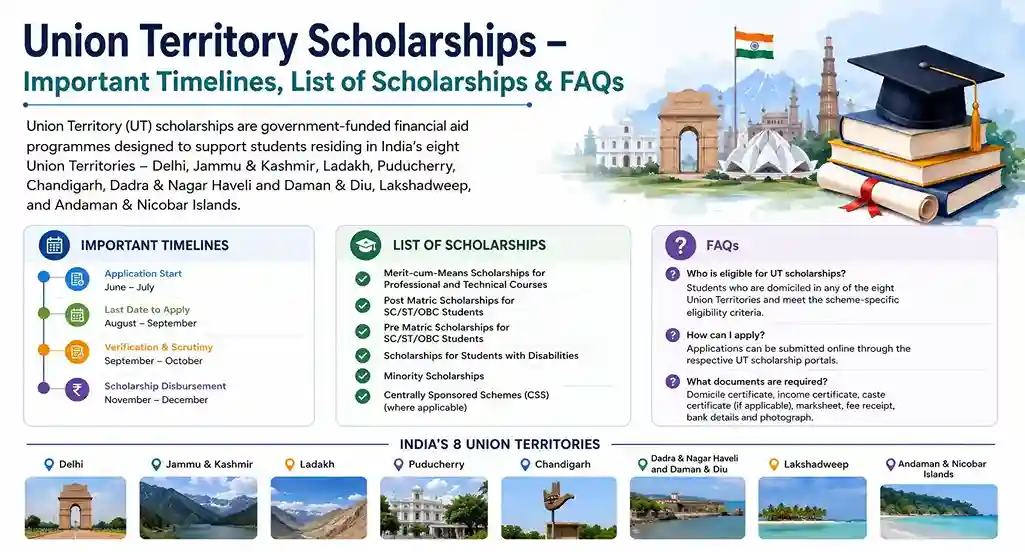
Are you a student living in one of India’s Union Territories? If yes then this article is just for you.
India has 8 Union Territories – Delhi, Jammu and Kashmir, Ladakh, Puducherry, Chandigarh, Dadra and Nagar Haveli and Daman and Diu, Lakshadweep and Andaman and Nicobar Islands. Each of these territories has its own scholarship programs to help students from all backgrounds continue their education.
In this complete guide we cover everything about Union Territory Scholarships 2026. You will find the full list of scholarships important timelines eligibility conditions required documents and application steps. Whether you are in Class 6 or doing your postgraduate – there is likely a scholarship waiting for you.
What Are Union Territory Scholarships?
Union Territory (UT) Scholarships are government-funded financial aid programs. They are designed to support students who live in India’s Union Territories. The central government along with each UT’s local administration runs these schemes.
These scholarships cover students from Class 1 all the way up to postgraduate level. They target students from SC, ST, OBC, Minority, EWS and general merit categories. The main goal is simple – make sure no student drops out of school or college due to a lack of money.
With the rising cost of education these scholarships are more important than ever. They cover tuition fees, books, hostel charges and even exam fees in some cases.
Union Territory Scholarships 2026 – Quick Overview Table
| Detail | Information |
|---|---|
| Scholarship Type | Government Funded Financial Aid (Pre-Matric and Post-Matric) |
| Offered By | Central Government and respective UT Administrations |
| Applicable Union Territories | Delhi, J&K, Ladakh, Puducherry, Chandigarh, DNH & DD, Lakshadweep, A&N Islands |
| Student Levels Covered | Class 1 to Postgraduate (UG, PG, Diploma, ITI, Ph.D) |
| Categories Covered | SC, ST, OBC, Minority, EWS, General Merit and Girls |
| Academic Requirement | Generally 50% to 60% in the qualifying examination |
| Income Limit (General) | Rs. 1,00,000 to Rs. 2,50,000 per annum (varies by scheme) |
| Age Limit | 18 to 35 years for most post-matric scholarships |
| Application Mode | Online through official UT portals or NSP (scholarships.gov.in) |
| Expected Application Period | July to October 2026 (varies by UT) |
| Payment Mode | Direct Benefit Transfer (DBT) via PFMS to Aadhaar-linked bank account |
| Central Portal | scholarships.gov.in |
Complete List of Union Territory Scholarships 2026
Here is the full list of Union Territories and their scholarship programs. Each UT has a dedicated set of schemes designed for students residing there.
1. Delhi Scholarships
Delhi offers some of the most popular UT scholarship programs in India. Schemes cover SC, ST, OBC and minority students from Class 9 to postgraduate level. The Delhi government also runs its own merit-based scholarships for meritorious students who score well in board exams.
Examples: Post-Matric Scholarship for SC/OBC/Minorities and merit scholarship for top-performing students.
2. Jammu and Kashmir Scholarships
After the reorganization of Jammu and Kashmir into a Union Territory in 2019 it now has dedicated UT scholarship schemes. The PMSSS (Prime Minister’s Special Scholarship Scheme) is one of the biggest schemes for J&K students who want to study in institutions outside J&K.
Examples: PMSSS, Post-Matric Scholarship for SC/ST and Consolidated Merit Scholarship.
3. Ladakh Scholarships
Ladakh became a separate Union Territory in 2019. Students from Ladakh can now access UT-specific scholarships along with centrally sponsored scholarship schemes. Given the remote geography of Ladakh these scholarships are especially important for students studying away from home.
4. Puducherry Scholarships
Puducherry runs a range of scholarships for students from Pre-Matric to postgraduate level. Both the central government and the Puducherry government offer schemes for SC, ST, OBC and minority students.
Examples: Puducherry State Scholarship, Post-Matric Scholarship and Merit Scholarship for Higher Education.
5. Chandigarh Scholarships
Chandigarh as a Union Territory runs several scholarship programs for its resident students. These cover students studying in recognized schools and colleges in Chandigarh. Schemes are available for SC, OBC and minority communities as well as meritorious students.
6. Dadra and Nagar Haveli and Daman and Diu Scholarships
This merged UT has scholarship programs available through the NSP portal. Students here can access both centrally sponsored schemes and UT-specific ones. Tribal students especially benefit from dedicated ST scholarship programs.
7. Lakshadweep Scholarships
Being a remote island territory Lakshadweep has special attention from the central government. Students from Lakshadweep who study on the mainland can avail scholarships for hostel accommodation and tuition fees. Applications are primarily done through the NSP portal.
8. Andaman and Nicobar Islands Scholarships
Students from the Andaman and Nicobar Islands can apply for scholarships through the National Scholarship Portal. Tribal and islander communities get additional support. The UT administration also runs merit scholarships for students excelling in board examinations.
Union Territory Scholarships 2026 – Official Portal List
| Union Territory | Official Portal |
|---|
Eligibility Criteria – General Rules for UT Scholarships
Eligibility varies from scheme to scheme. But here are the most common conditions that apply across most Union Territory (UT) Scholarships.
Academic Requirements
- Minimum 50% to 60% marks in the qualifying examination
- Must be a regular student in a recognized school or college
- Should not have failed or repeated the current academic year
- Must meet course-level requirements (UG, PG, Diploma, ITI etc.)
Domicile and Residency
- Must hold a valid domicile or residence certificate of the respective UT
- Usually requires 3 to 5 years of continuous residence in the UT
- School or college is often required to be located within the same UT
Income Criteria
- Annual family income must generally be below Rs. 1,00,000 to Rs. 2,50,000
- Income from all family sources is counted together
- BPL (Below Poverty Line) card holders usually get priority
Category and Community
- Dedicated schemes exist for SC, ST, OBC, Minority, EWS and Differently Abled students
- General category students may qualify under merit-based schemes
- Girl students often have separate reserved quotas in many UT schemes
Other General Conditions
- Applicants must not be receiving any other government scholarship at the same time
- The course must be approved by UGC, AICTE or the relevant regulatory board
- The bank account must be in the student’s own name and linked to Aadhaar
Important Timelines for UT Scholarships 2026
Timing is everything when it comes to scholarships. Missing the deadline means missing the money. So here is what you need to know about the expected schedule.
Most Union Territory Scholarships 2026 portals are expected to open between July and October 2026. However the exact dates differ by scheme and UT.
Here are some general timelines to keep in mind.
| Activity | Expected Period |
|---|---|
| Scholarship portals open for fresh applications | July to August 2026 |
| Last date to apply (most schemes) | October to November 2026 |
| Institute verification of applications | November 2026 |
| Defective application correction window | October to November 2026 |
| Scholarship disbursal (estimated) | December 2026 onwards |
Practical Tip: Do not wait for the last date. Many students miss out simply because they delay applying. Set a calendar reminder for July 2026 and keep checking the NSP portal regularly.
Documents Required for UT Scholarship 2026
Having your documents ready in advance saves a lot of time. Here is a checklist of the most commonly required documents.
Identity and Residency Documents
- Aadhaar card (mandatory for DBT-linked scholarships)
- Domicile or residence certificate issued by competent authority (SDM or Tehsildar)
- Ration card or voter ID as supporting address proof
- Birth certificate or Class 10 certificate for age proof
Academic Documents
- Marksheets of the last qualifying examination
- Bonafide or enrollment certificate from your current institution
- Admission letter or fee receipt of the current academic year
- Previous year’s marksheet (needed for renewal applications)
Category and Income Documents
- SC, ST, OBC or EWS certificate issued by SDM or competent authority
- Minority community declaration (for minority schemes)
- PwD certificate from a government medical board (if applicable)
- Income certificate issued by SDM or Tehsildar (usually within last 6 months)
- BPL card copy (if applicable)
Bank and Financial Documents
- Bank passbook front page or cancelled cheque (must be in the student’s name)
- Bank account must be Aadhaar-linked for direct benefit transfer
Other Documents
- Recent passport-size photographs
- Fee structure or demand letter from the institution
- Scanned signature of student and parent or guardian
How to Apply for Union Territory Scholarships 2026 – Step by Step
The application process is the same for most UT scholarship schemes. Here is a simple step-by-step guide.
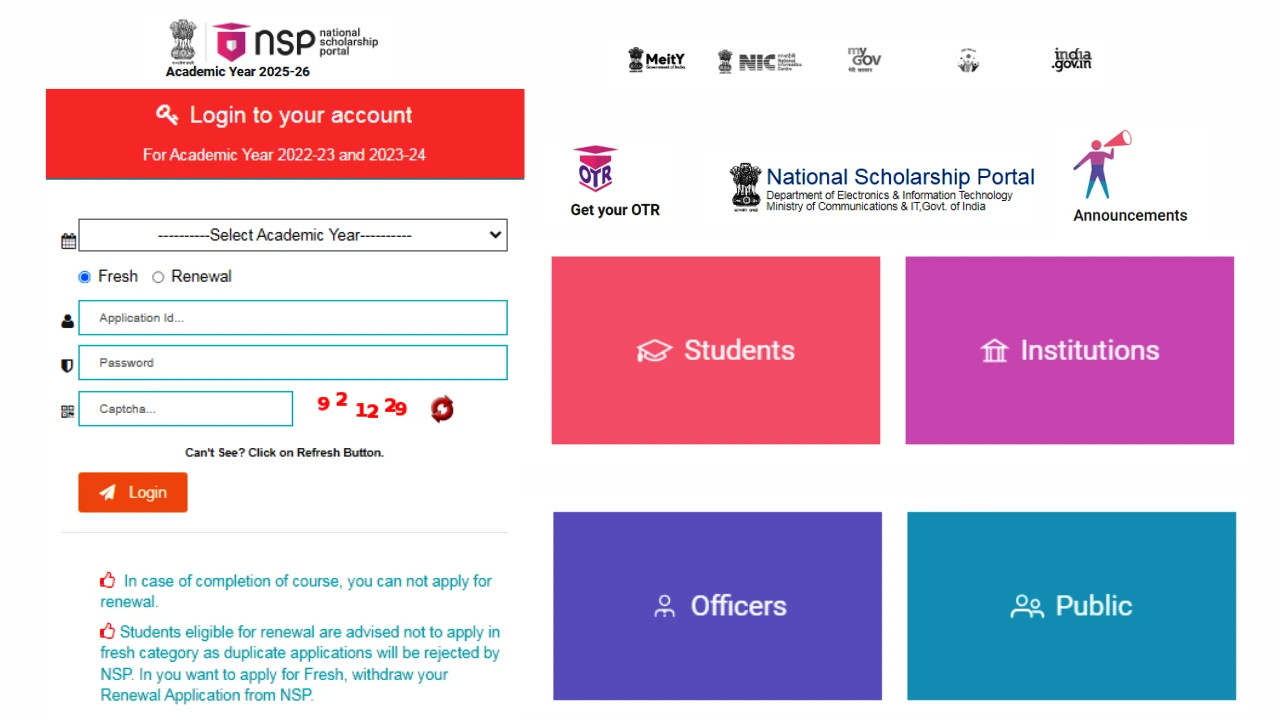
Step 1 – Visit the official portal at scholarships.gov.in (the National Scholarship Portal). Some UTs also have their own separate portals.
Step 2 – Register using your Aadhaar number mobile number and email ID. A new student needs to do a fresh registration each year.
Step 3 – Log in and select the scholarship scheme you want to apply for. Choose the one that matches your category and course level.
Step 4 – Fill in all details carefully. Include your personal academic bank and category information. Double-check before moving ahead.
Step 5 – Upload all required documents in the specified file size and format (usually JPG or PDF).
Step 6 – Submit your application and note down the application or registration number. Take a printout of the confirmation page.
Step 7 – Get your form verified by your school or college within the deadline. Unverified applications are automatically rejected.
Step 8 – Keep tracking your application status on the portal. If it shows a defect correct it within the correction window.
Practical Tip: Always use your school or college’s official email address while registering. Many applications fail institute verification because of a mismatch in contact details.
How is the Scholarship Amount Paid?
UT scholarship amounts are transferred directly to your Aadhaar-linked bank account. This is done through the Direct Benefit Transfer (DBT) system using PFMS (Public Financial Management System).
There is no middleman involved. The money goes straight from the government to your bank account. This makes the process transparent and fast.
Make sure your bank account is active and in your own name. Any mismatch between your Aadhaar details and bank records can cause payment failure or even rejection of your application.
Practical Tips to Increase Your Chances
Here are some smart tips that can help you get your scholarship without issues.
- Apply as early as possible. Do not wait for the deadline.
- Keep all documents scanned and ready before you start the form.
- Check that your income certificate is dated within the last 6 months.
- Make sure your Aadhaar is linked to your bank account before applying.
- Always use your own bank account. Never use a parent’s account for DBT scholarships.
- Get your application institute-verified before the deadline. This is a step many students miss.
- Do not apply for two scholarships of the same type at the same time. It leads to automatic rejection.
Conclusion
Education should never stop because of money. And that is exactly what Union Territory Scholarships 2026 are here for.
Whether you live in Delhi, Ladakh, Lakshadweep or any other Union Territory there are real scholarships available for you right now. All you need to do is check your eligibility gather your documents and apply online before the deadline.
Most UT scholarship portals open between July and October 2026. Bookmark this page and the National Scholarship Portal at scholarships.gov.in to stay updated.
Do not let a missed deadline come between you and your education. Start preparing today and give yourself the best chance at getting funded for the academic year ahead.
Frequently Asked Questions (FAQs)
Q1. What are Union Territory Scholarships and who are they for?
Union Territory Scholarships are government-funded financial aid programs offered to students residing in India’s 8 Union Territories – Delhi, Jammu and Kashmir, Ladakh, Puducherry, Chandigarh, Dadra and Nagar Haveli and Daman and Diu, Lakshadweep and Andaman and Nicobar Islands. They cover students from Class 1 up to postgraduate level across categories like SC, ST, OBC, Minority, EWS and General Merit.
Q2. What is the last date to apply for UT Scholarships 2026-27?
The last date varies by Union Territory and scheme. Most UT scholarship portals including those for Delhi, Chandigarh, Puducherry, Jammu and Kashmir, Ladakh, Lakshadweep and Andaman and Nicobar Islands are expected to open between July and October 2026. Always check the official NSP portal at scholarships.gov.in for the exact dates.
Q3. Can I apply for both a UT scholarship and an NSP scholarship at the same time?
Yes, in most cases you can apply for both a Union Territory scholarship and a central government scholarship listed on the NSP portal, as long as you meet the eligibility for each scheme. However some UT schemes have a no-duplication clause. If you are already getting a centrally sponsored scholarship like Post-Matric Scholarship for SC/ST you may not be eligible for the same category under a UT scheme. Always check the individual scheme’s terms before applying.
Q4. What documents are required to apply for a UT Scholarships in 2026?
Commonly required documents include a valid UT domicile certificate, caste or community certificate, income certificate not older than 6 months, last year’s marksheet, Aadhaar card, Aadhaar-linked bank passbook or cancelled cheque, bonafide certificate from your institute, fee demand letter and a recent passport-size photograph. Students under PwD or minority schemes may also need a disability certificate or minority community declaration.
Q5. How is the scholarship money transferred to students?
UT scholarship amounts are transferred directly to the student’s Aadhaar-linked bank account through the Direct Benefit Transfer (DBT) system via PFMS (Public Financial Management System). No middleman is involved. The money goes straight to your bank account. Make sure your bank account is active and in your own name with your Aadhaar properly linked. Any mismatch can result in failed payment or rejection of your application.
Read More: AYUSH Scholarship 2026-2027

Menka Singh is an education researcher and scholarship consultant with over 5 years of experience helping Indian students navigate central, state and private scholarship programmes. Having personally applied for and received scholarships during her own education, she brings firsthand understanding to every guide she writes. She specialises in Bihar, UP, Maharashtra and all India scholarship schemes and has helped thousands of students find verified funding opportunities. Read More: Click Here



Leave a Reply