
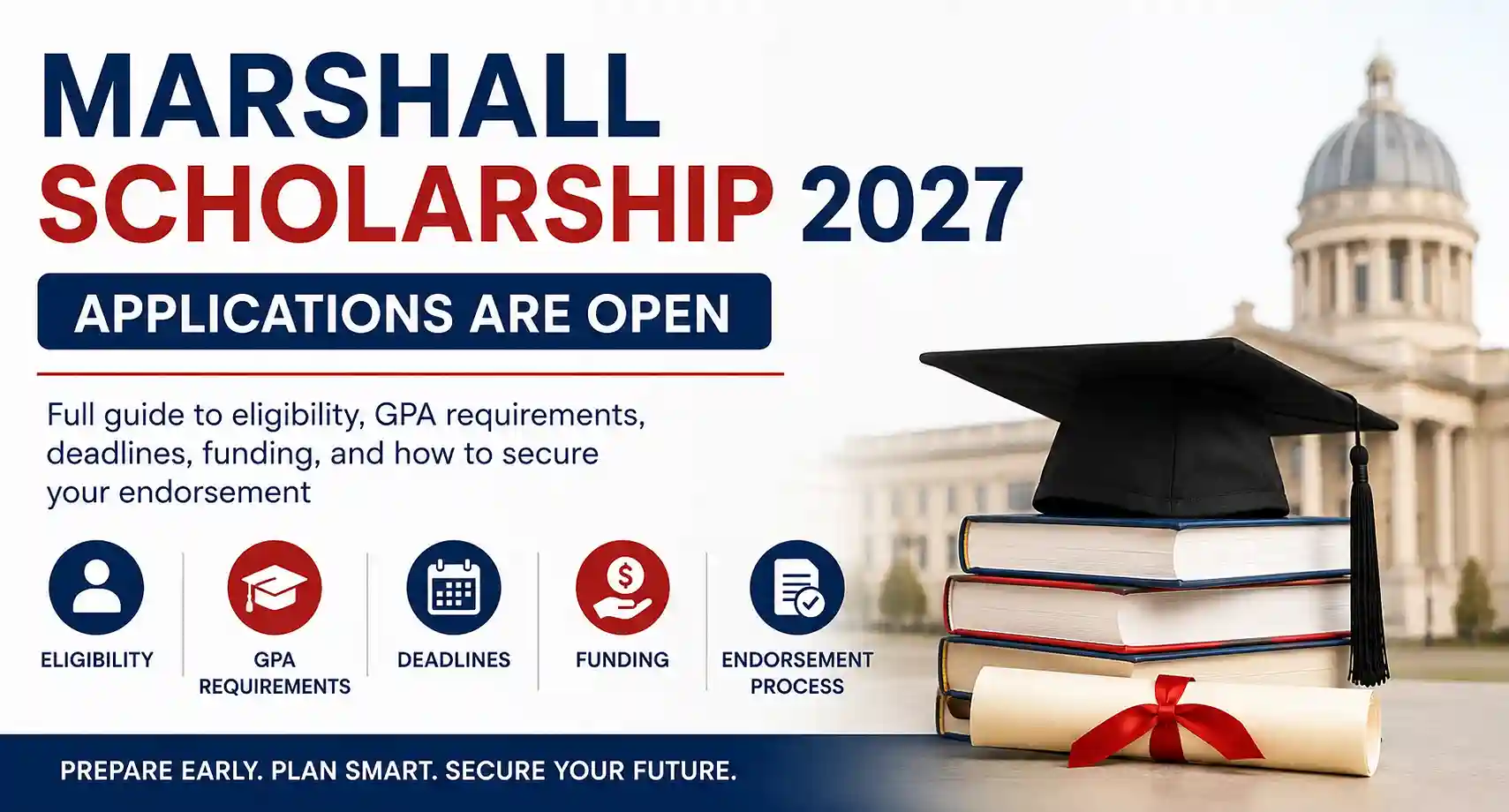
Applications for the 2027 Marshall Scholarship are officially open, giving outstanding American graduates the chance to study for free at any UK university – fully funded, for up to three years. Up to 50 scholars are selected each year, making it one of the most competitive graduate scholarships available to US citizens.
This guide walks through exactly who qualifies, what the scholarship actually pays for, the real deadlines you need to hit (including the internal university deadlines most guides skip), and how the selection process works from application to interview.
Marshall Scholarship 2027: Key Facts at a Glance
| Detail | Information |
|---|---|
| Awarding body | Marshall Aid Commemoration Commission (UK Government) |
| Who it’s for | US citizens with a bachelor’s degree from an accredited 4-year US institution |
| Minimum GPA | 3.7 on a 4.0 scale (not rounded) |
| Graduation window | After April 2024, for study starting September 2027 |
| Where you study | Any university in the United Kingdom, any field |
| Number of awards | Up to 50 annually |
| Duration | 1–3 years, depending on pathway chosen |
| National deadline (applicants) | 29 September 2026, 5:00 PM (endorsing institution’s time zone) |
| National deadline (institutional endorsement) | 1 October 2026, 5:00 PM |
| Interviews | Early–mid November 2026 |
| Official site | marshallscholarship.org |
Read More: Shamanur Shivashankarappa Scholarship 2026
What the Marshall Scholarship Actually Covers
Unlike partial-funding awards, the Marshall Scholarship is comprehensive. It covers:
- University tuition and fees in full
- A living stipend for cost-of-living expenses
- An annual book grant
- A thesis grant (for research-based programs)
- Research and daily travel grants
- Round-trip airfare between the US and UK
- A contribution toward supporting a dependent spouse, where applicable
This is what separates it from many “prestigious” scholarships that only cover tuition — the Marshall is designed so cost is not a barrier to accepting the offer.
Who Is Eligible?
To apply for the 2027 competition, you must:
- Be a US citizen at the time of application
- Hold your first undergraduate degree from an accredited four-year college or university in the United States, by the time you take up the scholarship (September 2027)
- Have a GPA of at least 3.7 on a 4.0 scale at the time of application — the Commission does not accept rounded GPAs, so a 3.69 does not qualify
- Have graduated after April 2024
- Not have studied for, or already hold, a British degree, degree-equivalent qualification, GCSEs, or A-Levels taken at a UK school
If any of these don’t apply to you — for example, you’ve already completed a UK master’s — you are not eligible, regardless of how strong your application would otherwise be. Double-check this before investing weeks into essays and reference requests.
The Five Study Pathways
A Marshall Scholarship isn’t a fixed “one program” award. You choose from five funding pathways:
- One-year pathway: a single one-year master’s degree (minimum 10-month program)
- Two consecutive one-year master’s degrees, at the same or different UK universities
- A single two-year master’s degree at one university
- A funded doctoral pathway (up to 3 years, discretionary third-year funding)
- One-year master’s + start of a PhD/DPhil in year two — the Commission guarantees two years of funding here, with a third year possible on a discretionary basis; scholars often need external funding to finish the doctorate afterward
Choose carefully: you can only apply for the one-year or two-year track — never both. Applying for both results in automatic disqualification.
Application Requirements
- Complete applications are submitted through the Marshall online application system
- You apply in one region only — either where you have your permanent home address/residence, or where you’re currently studying
- You need three letters of recommendation
- Your undergraduate institution must endorse your application — this is not optional. The endorsement must come from a President, Provost, Academic Dean, or another designated institutional official
- No institution can submit more than 24 endorsed applications total, though there’s no cap on how many can go to a single region
The Deadline Most Guides Get Wrong
Almost every article on this scholarship repeats the two national deadlines — 29 September and 1 October 2026 — and stops there. That’s only half the picture.
Your actual deadline is whatever your own university sets internally, and those are often 6–12 weeks earlier than the national deadline. For example, based on published campus timelines from past cycles:
| University | Internal deadline pattern |
|---|---|
| Harvard | Intent to Apply ~July 1; full endorsement application ~July 21 |
| University of Pennsylvania | ~July 31 |
| USC | ~June 21 |
| UC Berkeley | ~mid-August |
| University of Washington | Spring nomination process, opening as early as March |
(Always confirm your own institution’s current-cycle dates directly with your fellowships office — these vary year to year and by school.)
The practical takeaway: if you’re only tracking the 29 September national deadline, you may have already missed your university’s internal cutoff. Contact your fellowships/advising office now, not in September.
How Selection Works
- Institutional endorsement — your university reviews and either endorses or declines to forward your application.
- Regional review — endorsed applications are reviewed at one of eight regional US centers.
- Interview invitations — shortlisted candidates are contacted, typically early-to-mid November.
- Interviews — panels assess intellectual distinction, leadership potential, ambassadorial qualities, and commitment to UK-US understanding.
- Decision — results are announced shortly after interviews conclude. If selected, you must accept or decline in writing within 5 days.
- UK university admission — your scholarship is contingent on securing admission to an eligible UK program; the award and the admission are separate processes that both need to succeed.
What Selection Committees Are Actually Looking For
Beyond GPA and test scores, committees weigh:
- Intellectual distinction — not just grades, but original thinking and depth in your field
- Leadership potential — demonstrated, not just claimed
- Ambassadorial quality — genuine interest in UK-US relations, not a boilerplate line in a personal statement
- Communication skills — your personal statement and interview performance both matter heavily
- Integrity and character
- Likely contribution to society in your chosen field after the scholarship ends
Common Mistakes That Sink Strong Applications
- Missing the internal campus deadline by focusing only on the national dates
- Applying for both the one-year and two-year pathway (automatic disqualification)
- Proposing a UK program you’re not actually eligible or prepared for — reviewers can tell when a course choice doesn’t match your academic background
- Generic “ambassadorial” language in personal statements instead of specific, honest reasoning for why UK study and this particular program
- Waiting to request recommendation letters — three strong, specific letters take time; ask well before your internal deadline, not the national one
Frequently Asked Questions
Can I apply if I already hold a UK degree? No. Anyone who has studied for or holds a British degree, degree-equivalent qualification, or GCSEs/A-Levels from a UK school is not eligible.
Do I apply directly to the Marshall Commission? No — you apply through your undergraduate institution, which must endorse and submit your application on your behalf.
Can I choose both the one-year and two-year pathway to improve my odds? No. You must choose one. Applying for both results in automatic disqualification.
What GPA do I need? A minimum of 3.7 on a 4.0 scale, unrounded, at the time of application.
How many scholarships are awarded each year? Up to 50, across eight US regions.
When will I know if I was selected? Interviews happen in early-to-mid November 2026, with decisions announced shortly after. You then have 5 days to accept or decline.
Is the scholarship still valid if I don’t get into a UK university? No — the award is contingent on you securing admission to an eligible UK program.
Final Thoughts
The Marshall Scholarship’s national deadlines — 29 September and 1 October 2026 — are real, but they’re rarely the deadline that actually matters to you. If you’re a US citizen with a 3.7+ GPA, graduated after April 2024, and haven’t already studied in the UK, your very next step isn’t drafting a personal statement — it’s contacting your university’s fellowships office today to find out your actual internal deadline, which may already be weeks away.
This article is for informational purposes. Confirm all current eligibility rules, deadlines, and application steps directly on the official Marshall Scholarship website before applying, as details can be updated between cycles.

Menka Singh is an education researcher and scholarship consultant with over 5 years of experience helping Indian students navigate central, state and private scholarship programmes. Having personally applied for and received scholarships during her own education, she brings firsthand understanding to every guide she writes. She specialises in Bihar, UP, Maharashtra and all India scholarship schemes and has helped thousands of students find verified funding opportunities. Read More: Click Here



Leave a Reply